

What Is Seaglass? How It Forms, Where to Find It, and Why It Feels So Meaningful

Updated: Sep 2

My morning walks often end at a neighborhood beach where I source most of the seaglass I use in my artwork. My mind and mood shift when I step on the sand. My focus and vision sharpen. I become fully present in a way that most reliably happens here.
I live in Connecticut, where the beaches are rocky and what seaglass remains is not easy to find. As I step onto the beach, I'll typically stop for a few breaths, take in the view, scan the horizon, familiar as it is, for new things to notice. Sometimes a lighthouse or a far-away landscape zooms into sharp focus, bright and brilliant in the sunlight; sometimes a powdery haze softens everything into chalky pastels. If the tide is high, I listen as the waves slap the sand. If low, I can catch a cool, earthy undertone of mud in the briny air. When I bring my gaze downward, the sand feels rich with possibility.
There is a science to searching for seaglass. My brain has gotten good at sorting what I see into patterns and noticing anomalies. A speck of color pops, an opaque shard gleams a brighter white than the creamy shells around it. What catches my eye may be a beautifully formed piece, sanded by tides or a pleasingly misshapen, hunky chunk, satisfying to hold. I expect to find surprises and things that will make me happy and almost always, I do.
What IS Seaglass?
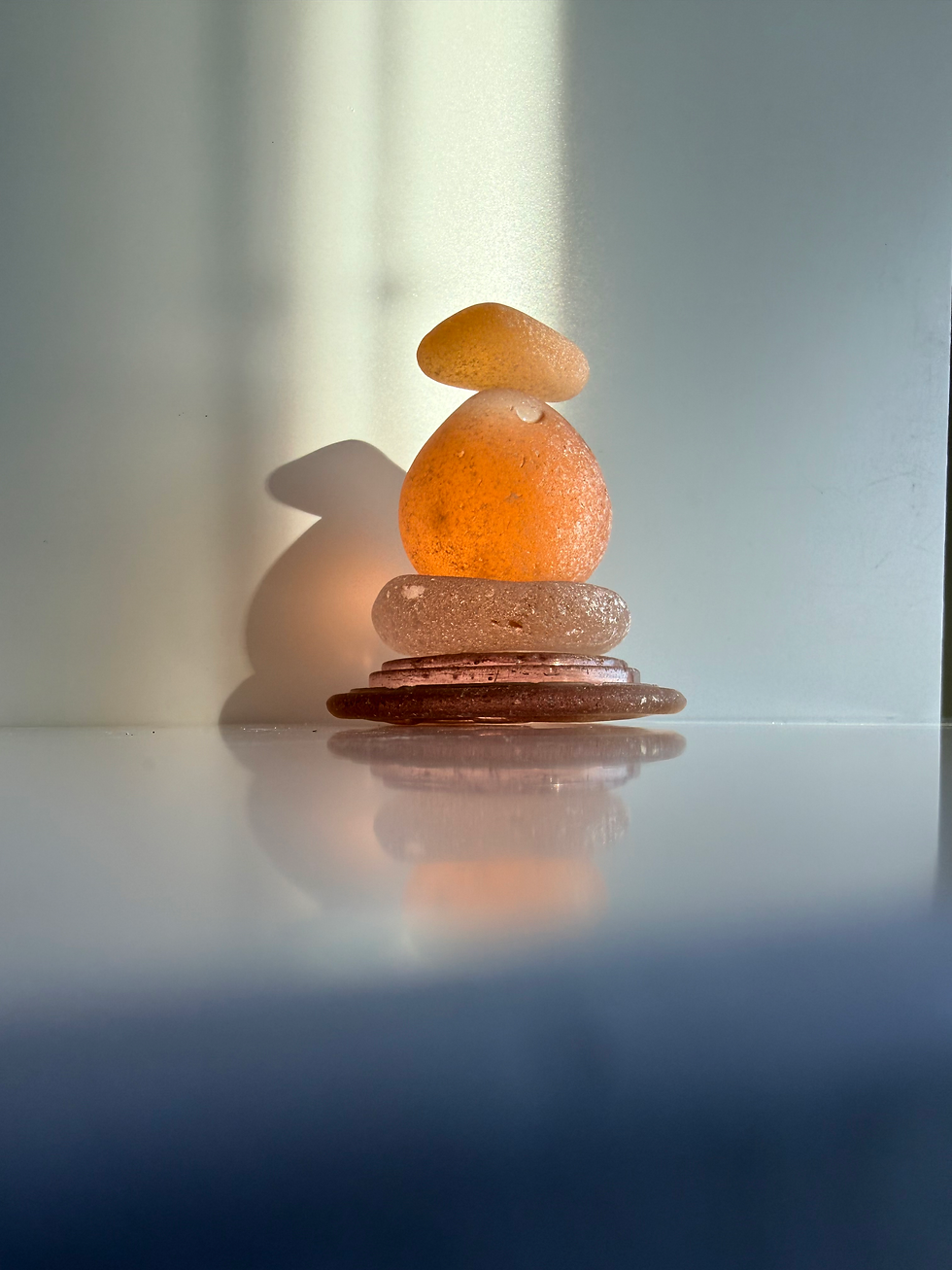
Seaglass is ordinary glass, formerly useful or decorative, that has been sculpted by water and sand into something entirely different. My collection includes bits of bottles, jars, dishes, taillights, vases and serving platters; also, lots of safety and privacy glass. By the time glass arrives on the shore it has been eroded and sandblasted by waves, water and rocks over many years, even centuries. What was once household trash has been transformed by time and turbulence pieces that are smooth, luminous. The color -- whether emerald green, cobalt blue, cloudy white or a cool aqua -- holds light differently. Each piece is both an accident and specific unto itself. ,
WHERE TO FIND SEAGLASS
Seaglass can be found on any beach, anywhere in the world, but some beaches have more of it than others. I find the highest yield in towns and cities by the water, areas where people have lived for decades or longer.
Look for:
Older coastal cities with a history of industry
Beaches near landfills or dumps
Small, pebbly beaches, which more readily catch and hold seaglass
Shorelines with steady, rhythmic waves
Tidal zones, most especially just after a storm or tidal current
Cloudy days, or any early morning or late afternoon tend to be best for seaglass searching because color and texture are more visible in low light. But as important is timing is that you are looking closely and paying attention to what you see. Take your time. This is a skill that -- as with everything -- improves with practice.
WHY SEAGLASS FEELS MEANINGFUL
There are, of course, practical reasons why people are drawn to seaglass. It is pretty. It is collectible. It is increasingly rare, some pieces incredibly so. Not coincidentally for me, it is also an excuse to spend time on the beach. But the symbolism is important too.
Seaglass holds history, possibility, promise. It's not conventionally beautiful or useful or flawless or expensive but I and many others are drawn to it. It's reassuring to understand that the process of breaking does not have to diminish us; it can bring us to something better.
For me, collecting seaglass is less about accumulation (though I certainly have lots of it) and more about attention and observation. My obsession has trained me to look more closely, to engage the world with greater focus and creativity. My mind plays with metaphor. I think about color, shape, light and the way objects relate to one another in composition. I curate and update my collection, use and reuse my pieces and have particular favorites you'll see again and again in my work.

Comments